
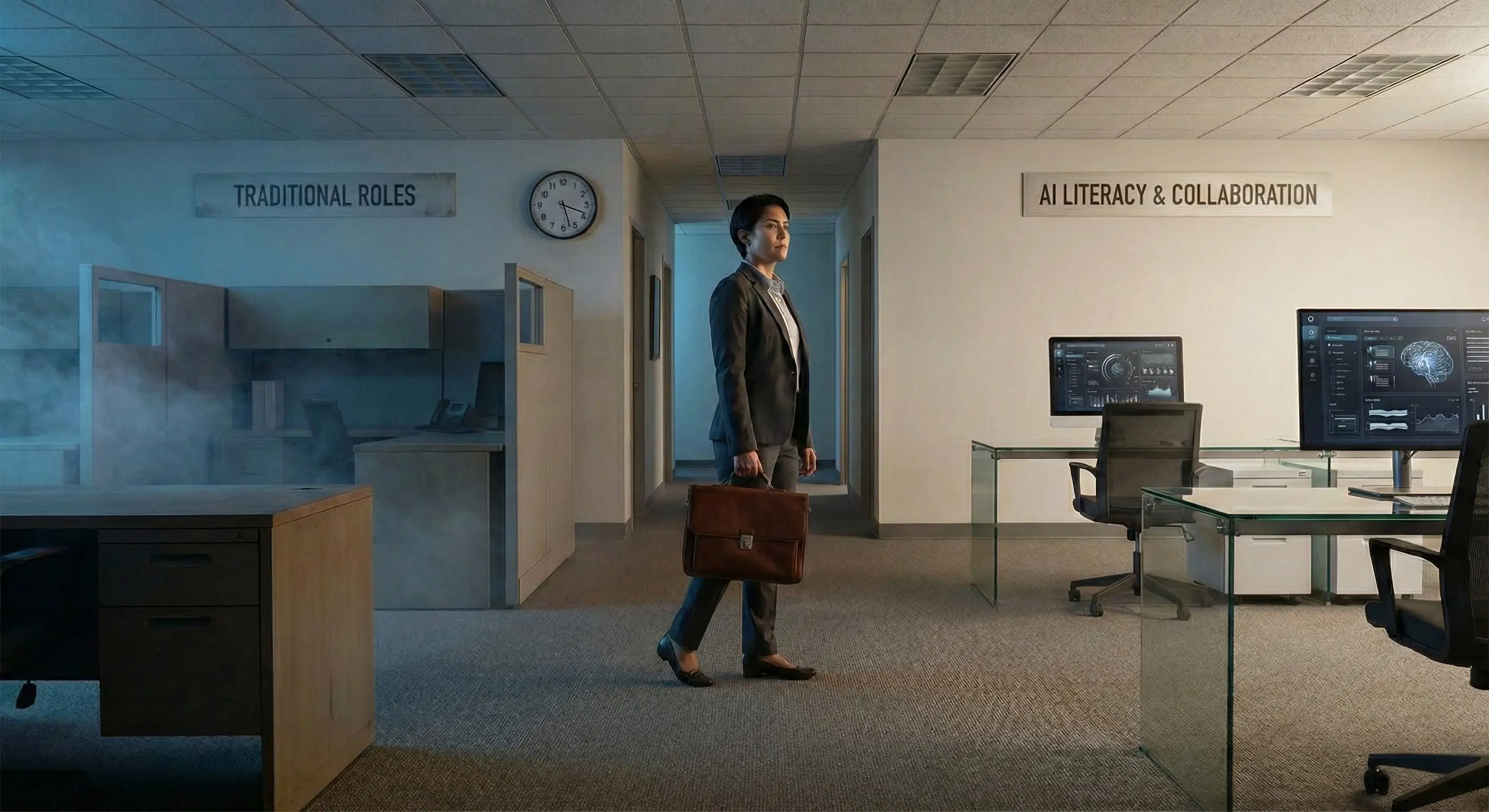
As AI moves from hype to deployment, the global workforce faces not mass unemployment—but radical transformation across every major sector.
Published: February 2026
The labor market of 2026 defies simple categorization. While headlines oscillate between “AI apocalypse” and “massive opportunity,” the reality unfolding across developed economies is far more nuanced: a fundamental rebalancing of how work gets done, who does it, and what skills command a premium.
According to the World Economic Forum’s Future of Jobs Report 2025, the global economy will experience structural churn involving the displacement of 92 million roles and the creation of 170 million new ones by 2030—a net gain of 78 million positions. However, this aggregate positive masks severe friction: the skills required for emerging roles bear little resemblance to those possessed by displaced workers.
The defining characteristic of 2026 is what economists call the “decoupling of productivity from headcount.” Goldman Sachs projects “sturdy” global GDP growth of 2.8%, driven primarily by massive capital expenditures in AI infrastructure rather than human hiring. This creates a paradox: economic expansion without proportional job creation, as productivity gains allow companies to maintain or grow revenue while freezing headcount.
This article examines the major labor market shifts occurring across five critical sectors—technology, creative industries, healthcare, logistics, and finance—identifying which roles face displacement, which are transforming, and which are newly emerging in 2026.
The Macro Context: From AI Hype to AI Deployment
The speculative “AI hype” that characterized 2023-2024 has dissipated, replaced by what Forrester calls the “hard hat” phase—a rigorous, capital-intensive deployment cycle focused on measurable ROI. Organizations are no longer asking if they should adopt AI, but rather calculating the specific returns on productivity, headcount reduction, and operational resilience.
Stanford HAI faculty characterize 2026 as the moment AI confronts its “actual utility”—the era of AI evangelism giving way to rigorous evaluation. Companies are seeking to replicate what industry observers call the “Klarna Model,” where the Swedish fintech achieved high revenue per employee through aggressive automation of support and marketing functions.
However, Klarna’s experience also illustrates the limits of pure automation. After replacing customer service agents and marketing staff in 2024-2025, the company was forced to rehire human agents by mid-2025 when customer satisfaction declined and operational issues emerged around complex, high-empathy interactions. This “U-turn” demonstrates the central tension of 2026: AI excels at volume and routine tasks but struggles with nuance, edge cases, and genuine empathy.
The International Labour Organization warns that this transition is creating a “K-shaped” labor market globally, with high-income countries shifting toward high-skill employment while low- and middle-income countries face widening digital divides and deeper inequalities.
Technology: The Junior Gap Crisis
The technology sector, once the undisputed engine of middle-class job creation, faces its most significant restructuring since the dot-com bubble. The defining narrative of 2026 is the evaporation of entry-level pathways for software engineers—what industry observers call the “Junior Gap.”
Research shows that one senior engineer equipped with tools like GitHub Copilot can now output the volume of three 2020-era junior developers. The economic rationale for hiring juniors—to handle boilerplate coding, unit testing, and documentation while learning complex architecture—has broken. AI agents excel at precisely these tasks, with speed and accuracy entry-level developers cannot match.
The impact is visible in employment data. Computer science and computer engineering graduates face unemployment rates of 6.1% and 7.5% respectively—significantly higher than the national average of 4.3% and dramatically elevated compared to fields like nursing (1.4%). Even top students from prestigious universities report applying to 300+ entry-level positions with zero callbacks.
Yet this displacement creates a structural crisis: if the industry doesn’t hire juniors in 2026, there will be no mid-level developers in 2029 and no senior architects in 2033. The industry is “eating its seed corn” by relying solely on senior talent augmented by AI, creating a future scarcity of experts who understand fundamental principles rather than relying on AI abstraction layers.
Emerging Tech Roles
As traditional coding roles decline, new specialized positions are emerging focused on AI orchestration rather than manual coding:
Context Engineer: Responsible for designing knowledge retrieval systems (RAG – Retrieval-Augmented Generation) that ground AI agents in accurate business context, preventing hallucinations and ensuring outputs align with enterprise reality.
Trust & Safety Engineer: With Gartner identifying trust as the #1 AI challenge for 2026, these professionals validate safety, ethics, and reliability of AI outputs, particularly in regulated industries, acting as quality assurance for the AI age.
Agentic Workflow Architect: Designers of the logic gates, decision trees, and permissions that allow multi-agent systems to collaborate on complex tasks—effectively managers of the digital workforce.
Creative Industries: Consolidation and the Agency Crisis
The creative sector serves as the “canary in the coal mine” for generative AI displacement. By 2026, disruption is visible in corporate P&L statements, agency restructurings, and the fundamental redefinition of creative work itself.
Major advertising holding companies are aggressively restructuring. WPP, the world’s largest advertising group, has announced major layoffs and organizational simplification to integrate AI capabilities. Ogilvy alone cut 700 jobs and dissolved its global DEI team to embrace a decentralized, AI-first model.
Goldman Sachs research indicates that employment growth in graphic design and marketing consulting has fallen below trend due to AI efficiency, with generative AI capable of automating approximately 26% of tasks in arts and design. The market for basic, transactional creative work—logos, social media captions, stock imagery—is being obliterated as clients generate these assets internally using tools like Midjourney and Adobe Firefly.
The Role Transformation
Professional designers and writers are evolving from creators to curators. The role shifts from generating initial drafts to editing, refining, and selecting the best output from AI—requiring “taste” and “judgment” rather than technical execution.
Brand Governance Specialist has emerged as a critical new role. With decentralized teams using AI to generate vast content volumes, these professionals ensure all AI-generated assets align with strict brand guidelines, managing the “style weights” of corporate AI models to maintain consistency.
AI Workflow Orchestrator is another emerging position, where mid-level creatives who survived agency restructurings now manage “generative content engines” for major clients, producing 100x the assets with smaller teams.
Healthcare: The Human Firewall
In stark contrast to technology and creative sectors, healthcare presents a narrative of resilience. Here, AI serves as a “survival tool” for a workforce pushed to breaking point, rather than a replacement mechanism. The fundamental driver is supply-demand imbalance: aging populations require more care than available human workforce can provide, making automation essential for capacity expansion, not cost-cutting.
By 2026, AI medical scribes have become standard infrastructure in U.S. hospitals and clinics. The American Medical Association reports that ambient AI systems listening to patient-doctor consultations and auto-generating clinical notes save approximately 15,000 hours of documentation time, allowing clinicians to focus on patient interaction rather than keyboard clicks.
Studies show these systems achieve 95-98% accuracy, removing hours of daily administrative burden and serving as a critical retention tool to prevent burnout. The doctor-patient relationship is being restored as the “keyboard barrier” disappears.
The victims of this innovation are medical transcriptionists and human medical scribes—roles involving manual transcription of dictated notes that face “imminent risk” of total automation. However, displaced scribes are finding pathways into emerging roles around AI quality assurance and clinical documentation oversight.
Healthcare Role Evolution
Radiologists, once feared to be among the first medical professionals replaced by AI, instead demonstrate the “super-user” model. With a projected global shortage of 122,000 radiologists by 2032, AI algorithms now pre-screen scans, prioritize urgent cases, and flag anomalies for human review. This shifts radiologists from “searching for needles in haystacks” to “verifying needles found by AI,” allowing them to handle higher case volumes without compromising accuracy.
Nurses are seeing roles expand into “Digital Care Coordination,” with experienced nurses working from command centers to monitor patients via sensors and AI dashboards, guiding bedside staff. This Virtual Nursing model allows older, experienced nurses—who may struggle with 12-hour shift demands—to remain in the workforce, leveraging clinical judgment remotely.
Logistics and Manufacturing: Physical AI Goes Commercial
2026 marks the breakthrough year for Physical AI—the application of artificial intelligence to robots, trucks, and physical infrastructure. Unlike generative AI confined to screens, this “physical” AI moves atoms, transitioning from pilot projects to commercial scaling.
After years of testing, driverless trucks have become operational on specific U.S. interstate corridors. Companies like Aurora Innovation and Kodiak Robotics have launched commercial driverless lanes, particularly in the “Texas Triangle” (Dallas-Houston-San Antonio) and expanding across the Sun Belt to Phoenix and Atlanta.
The displacement is structural but not immediate. Premium long-haul Over-the-Road (OTR) jobs that pay best for highway miles are primary automation targets, while local “last mile” and complex urban driving remain human-dominated due to unpredictability. Displaced long-haul drivers are transitioning to Remote Fleet Monitor roles, overseeing convoys of autonomous vehicles from centralized command centers, ready to intervene when AI encounters edge cases.
Warehouse and Manufacturing Transformation
Amazon is reportedly planning to automate massive portions of its fulfillment network to avoid hiring an additional 500,000+ workers needed to meet growth targets. The warehouse worker role is transforming from “lifter and carrier” to “Robot Tender”—managing exception handling, fixing stuck robots, clearing jams, and managing automated system flow.
In manufacturing, the Digital Twin concept has reached maturity, with factories running virtual simulations of production lines to optimize efficiency before physical installation. The workforce shifts from manual assembly to “AI-informed monitoring,” using dashboards to predict maintenance needs and optimize production flow.
Finance: The Augmented Analyst and Teller Obsolescence
The finance sector offers the clearest example of workforce bifurcation: high-end “front office” roles are being supercharged by AI leverage, while “retail” roles face existential displacement.
In investment banking, generative AI is reshaping the traditional “leverage model.” Banks like Goldman Sachs and Morgan Stanley are realizing 20-35% productivity gains in tasks historically performed by armies of junior analysts: formatting slides, spreading comparables, summarizing research. The result is not mass firing of current analysts, but contraction in future hiring—banks need fewer analysts to support the same number of dealmakers.
This creates a similar “training gap” as seen in technology: how do you develop future Managing Directors if they never spend years doing the grunt work that taught them the business?
At the retail banking level, bank tellers face an 88% automation probability. As digital banking becomes ubiquitous and AI-powered kiosks handle complex transactions, the physical branch is being reimagined. Remaining branch staff transition to “Universal Banker” or “Financial Advisor” roles—sales and advisory positions utilizing AI tools to provide complex financial planning rather than transactional services.
Interestingly, smaller community banks are adopting AI to compete, with employees identifying automation use cases to level the playing field against larger institutions.
The Fundamental Skill Shift: From Creation to Curation
Across all sectors, a common pattern emerges: the shift from Creation to Curation. The premium moves from executing tasks to orchestrating systems, from generating outputs to evaluating quality, from individual contribution to AI-augmented leverage.
The old skill was writing code; the new skill is reviewing AI’s code for security and architecture. The old skill was writing copy; the new skill is selecting the best of 50 AI-generated headlines and refining tone. The old skill was driving the truck; the new skill is monitoring the fleet and managing logistics exceptions.
“Digital literacy” in 2026 no longer means “knowing how to use Microsoft Office.” It means AI Fluency—understanding how to prompt, how to chain agents together, how to evaluate model output, and grasping the ethical implications of AI decisions. This represents a fundamental redefinition of baseline workplace competence.
According to the World Economic Forum, 39% of core skills will change by 2030, with employers anticipating a 41% reduction in workforce for roles exposed to AI-induced skills obsolescence—but simultaneously reporting 90% of leaders see overcapacity in legacy roles alongside desperate shortages in AI-critical skills.
The Paradox of 2026: Displacement Without Unemployment
The labor market of 2026 is not facing an apocalypse of work, but a radical rebalancing. The simplistic narrative of “robots taking all the jobs” has proven false. Instead, we see a nuanced reality where AI takes tasks, and in doing so, fundamentally reshapes roles.
The danger for the coming years is not mass unemployment, but mass displacement and structural mismatch. We face a paradox: a surplus of entry-level digital talent the market no longer values, and a shortage of physical care and trade talent the market desperately needs. We see “sturdy” GDP growth driven by machines, decoupled from the hiring of humans.
For workers, the mandate is clear: move up the value chain. Shift from execution to orchestration. Shift from the digital back to the physical, or deep into the “human” skills of empathy and judgment. Research confirms that jobs least likely to be affected by AI—those involving teaching, caring, coaching, or physical tasks—account for 23% of workers, yet face the highest demand.
For policymakers and business leaders, the challenge is managing this transition—ensuring the “efficiency gains” of the AI age don’t result in a permanent underclass of displaced knowledge workers and a “training desert” for the next generation.
The “Future of Work” is no longer a prediction. In 2026, it’s a deployment schedule. The question isn’t whether AI will transform your industry—it’s whether you’re prepared for the specific ways that transformation is already underway.
Stay tuned for upcoming deep-dives into specific roles facing AI automation—and what workers and organizations can do to navigate the transition successfully.


Leave a Reply