
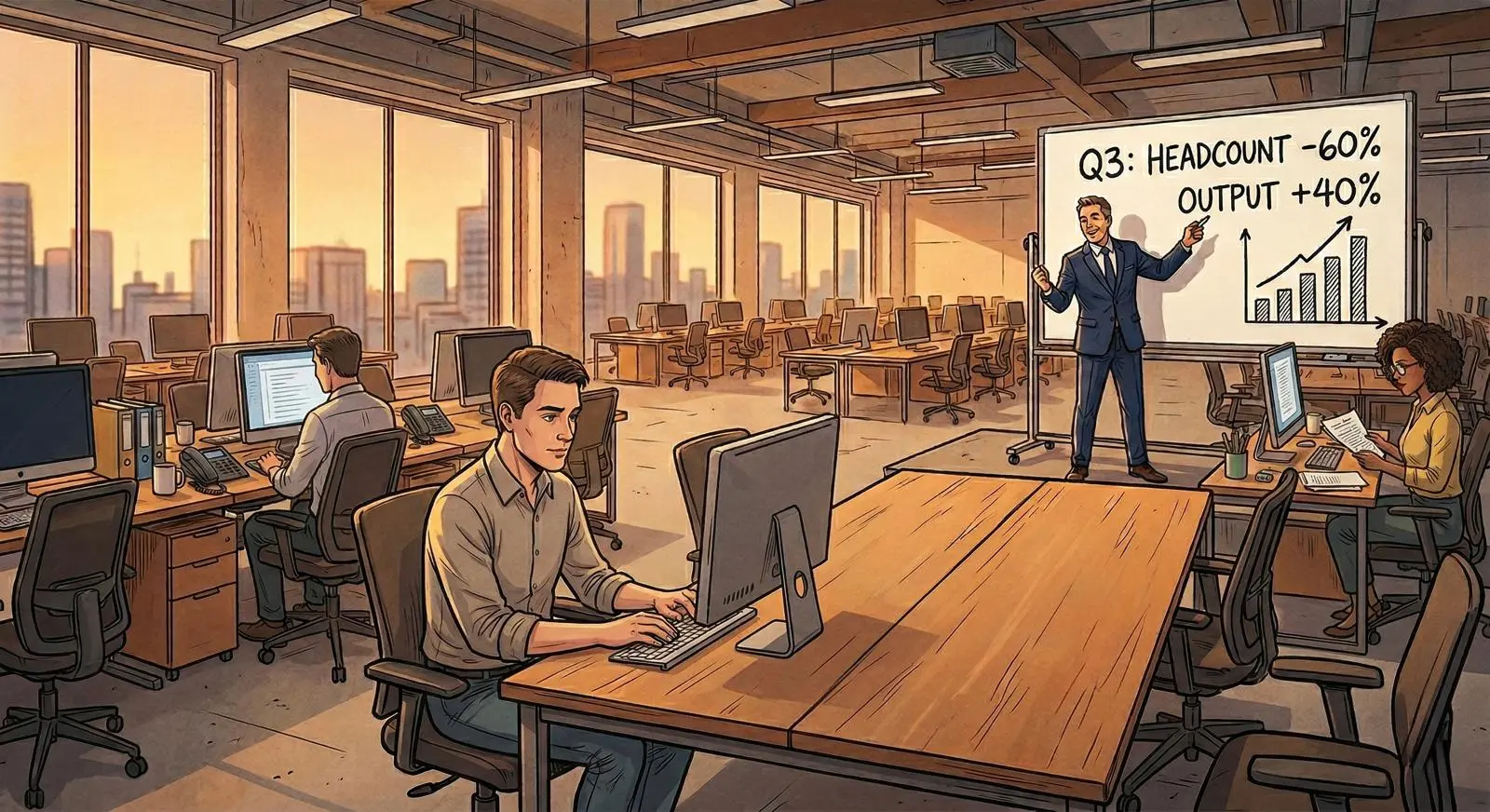
The memo went out quietly at BlueFocus, one of China’s largest advertising agencies. No consultation, no phased transition — just an announcement in 2023 that it would “fully and indefinitely” end all outsourcing of creative work, replacing external copywriters and designers with generative AI tools overnight. It wasn’t a pilot. It was a preview of things to come.
Welcome to marketing in 2026, where the question is no longer whether AI will disrupt creative careers, but how fast and how completely.
The Numbers Don’t Lie
The scale of AI’s takeover of the marketing industry is staggering. Today, 88% of marketers use AI tools in their daily workflow, with generative AI adoption doubling in a single year — from 33% in 2023 to 71% in 2024 and surging further since. GenAI now touches 15% of all marketing activities, a figure that represents a 116% year-over-year jump.
For businesses, the ROI case is ironclad. AI-driven campaigns deliver 22% higher returns and 32% lower customer acquisition costs compared to traditional methods. Marketers save an average of three hours per content piece. Entire campaigns are being planned, built, and optimized by autonomous “agentic” systems — with minimal human input required.
For workers, the math is considerably less friendly.
The Entry-Level Collapse
If you’re a recent marketing graduate, you’re entering a market that has quietly closed its doors to you. The roles that once welcomed junior talent — copywriting, basic SEO, social media captions, product descriptions — are being automated at scale.
Writing roles have declined 28% year-over-year. Junior marketing headcount for workers under 25 has fallen 19.2%. A landmark Stanford study found that since the widespread adoption of generative AI, early-career workers aged 22–25 in the most AI-exposed occupations — including marketing — have experienced a 16% relative decline in employment, with headcount in some roles falling as much as 20%. Forrester projects US advertising agencies will shed 32,000 jobs — 7.5% of their total workforce — to automation by 2030.
The traditional “learning-on-the-job” pathway, where ambitious graduates earned their stripes writing SEO blogs and product copy, has been outsourced to a language model.
The Authenticity Paradox
Here’s where it gets interesting. While AI is flooding the internet with content, consumers are pushing back. A full 52% say they would reduce engagement with a brand if they suspected AI-generated content. While only 33% of consumers believe AI can craft emotionally resonant writing, 77% of marketers claim it can.
That gap between professional confidence and audience reception is a 44-percentage-point chasm. “AI slop” is becoming a recognized phenomenon, and forward-thinking brands are now re-hiring human creative talent to restore distinctiveness to their flattened brand voices.
This paradox may be marketing’s most unexpected plot twist of the year.
Winners, Losers, and the Wage Gap
Not everyone is suffering. Workers who’ve embraced AI fluency are commanding a 56% wage premium over peers without AI skills — up from 25% just a year ago, according to PwC’s 2025 Global AI Jobs Barometer. That translates to roughly $18,000 more annually. Roles like AI Content Strategist, AgentOps Professional, and GEO (Generative Engine Optimization) Specialist are emerging as the new creative elite, directing fleets of AI agents rather than producing content themselves.
The teams furthest along the AI adoption curve report the highest job satisfaction and the lowest burnout — a counterintuitive finding that should force the industry to reckon with what “creative work” actually means in 2026.
What Survival Looks Like
For marketers navigating this landscape, the shift is from execution to orchestration. The copywriter who once wrote the brief now designs the system that generates it. The SEO specialist now engineers relevance within AI-generated search responses. The junior marketer who can’t find a foothold is pivoting to freelance “done-for-you” services, acting as an AI-literate implementation partner for small businesses who can’t afford full-scale agencies.
The hard truth? Those who frame AI as a threat to resist are already behind. Those who treat it as infrastructure to master are writing their own rules.
The creative industry isn’t dying. It’s forking into an automated execution layer and a premium human layer defined by voice, judgment, and genuine human perspective.
The question every marketer now faces is simple: Which layer do you want to be on?
Next week, we close out our deep-dive series on AI’s impact across professional roles with a look at financial analysts — a field long considered insulated from automation by the complexity of its judgment calls and the weight of its decisions. As AI models grow capable of processing earnings reports, modelling risk scenarios, and generating investment theses in seconds, that assumption is being put to the test. Stay tuned.


Leave a Reply