
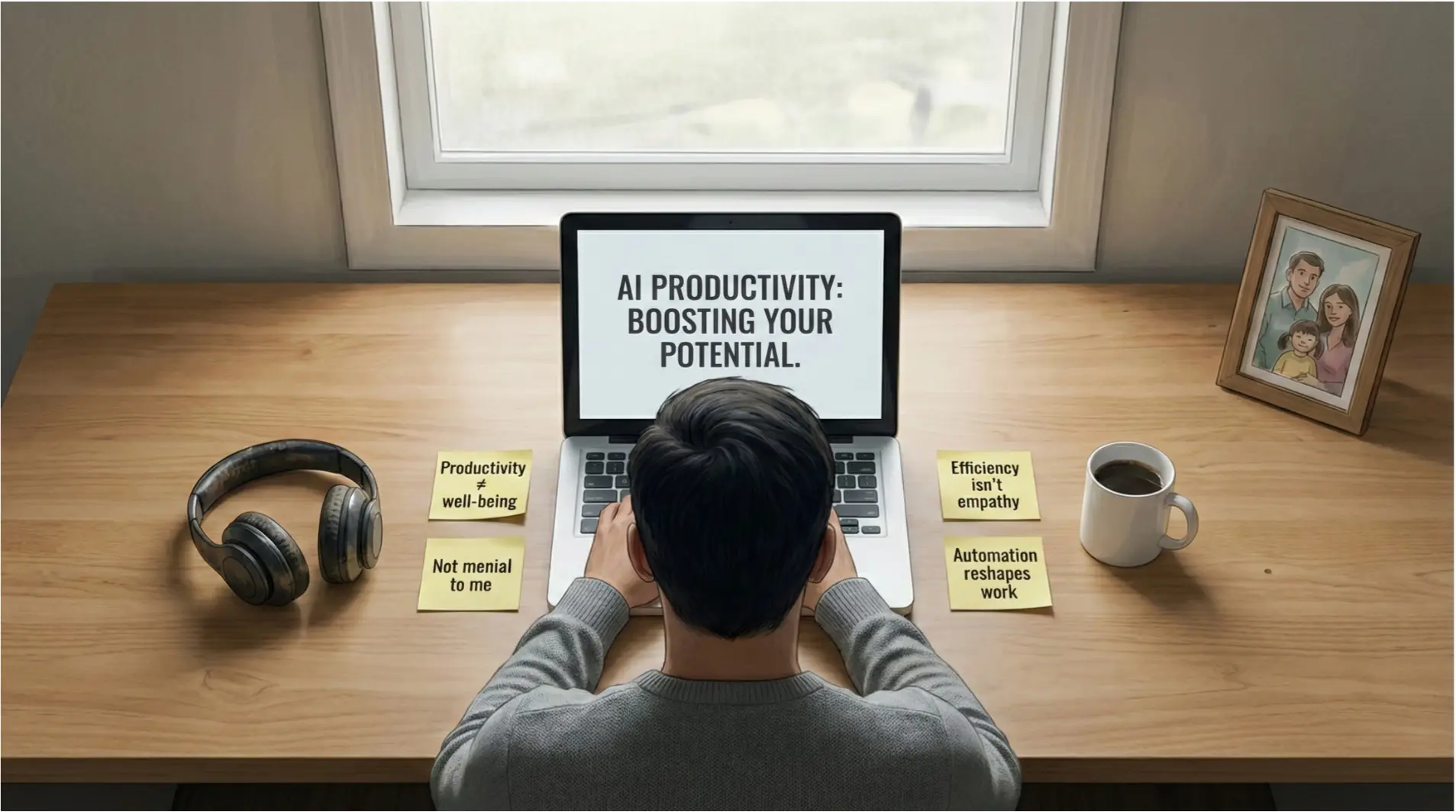
The Promise, the Friction and the Human Cost
Tech evangelists have long portrayed artificial intelligence as a liberator from drudgery. By automating repetitive tasks, they claim, AI will free humans to focus on creative, high‑value work. The narrative is seductive: no more spreadsheets or call‑centre scripts, just strategy and innovation. Yet for millions of people, those so‑called menial tasks are not drudgery but the very foundation of their livelihoods. As AI adoption accelerates, understanding its true impact on workers’ health and dignity becomes essential. Against this backdrop, younger employees increasingly deploy AI to skip meetings, move faster, and secure raises, even as they report mixed feelings and concern about longer-term dependence, a signal that productivity wins can coexist with unease. Many of the same forces described in Between Hype and Reality: How AI Is Impacting Real Workers also shape employees’ sense of security and identity
Early evidence paints a mixed picture. A 2025 peer-reviewed study drawing on two decades of German survey data found no substantial negative effects of AI exposure on job satisfaction or mental health. In fact, respondents reported modest improvements in physical well-being, likely because AI reduced physically demanding tasks (see CEPR). The International Monetary Fund estimates (as detailed in this study) that 40% of global employment is exposed to AI—rising to 60% in advanced economies—with roughly half of those jobs poised to benefit from productivity gains and the other half facing risks of displacement . Yet these findings come with caveats. The German study excluded younger workers—the group most vulnerable to automation—and Germany’s strong labor protections may shield employees in ways not replicated in more flexible markets. Evidence remains limited, and early optimism should be tempered by recognition of uneven risks.
Other research underscores the psychological strain that AI adoption can trigger. A recent Cureus article introduced the term Artificial Intelligence Replacement Dysfunction (AIRD) to capture the distress experienced by workers confronting job loss or the fear of obsolescence. The proposed syndrome describes a spectrum of symptoms, such as anxiety, depression, insomnia, demoralization and identity confusion, rooted less in workload changes than in existential concerns about relevance and employability. While AIRD is not yet a formal diagnosis, it reflects the growing reality that for many workers, the advance of AI is not simply a technical shift but a profound challenge to their dignity, purpose and stability.
The article also highlights ways to address this kind of distress. Rather than framing AI disruption purely as an economic problem, the authors suggest that mental-health professionals can help workers rebuild agency and reframe their stories of obsolescence. Approaches such as motivational interviewing, narrative therapy, cognitive restructuring, and mindfulness-based practices can support individuals in processing fears and regaining confidence. Beyond individual treatment, the authors urge clinicians to advocate more broadly: raising awareness of AI-related anxiety in healthcare systems, advising employers and unions on workforce transitions, and pressing for policies that include mental-health resources alongside retraining and job-placement programs. Recognizing these impacts underscores that the psychological consequences of AI adoption are every bit as significant as the financial ones.
Productivity vs. Burnout: The Upwork Paradox
If the first chapter of AI adoption was about efficiency, the second may be about the human cost. A July 2025 Upwork Research Institute survey of 2,500 workers in the US, UK, Australia and Canada reports that employees using AI experience an average 40 % boost in productivity and that 77 % of C‑suite leaders see productivity improvements (Upwork Research Institute). These gains stem from experimentation with new tools, product improvements and self‑directed upskilling. No wonder so many employers are eager to accelerate adoption. The paradox intensifies when workers who lean hardest on AI also report higher burnout and weaker alignment with company AI strategy, mirroring Gen Z’s pattern of embracing AI while harboring doubts about its long-term effects.
Beneath the headline, however, lies a troubling pattern: 88% of the highest‑performing AI users report burnout and are twice as likely to consider quitting. Many top performers feel disconnected from their company’s AI strategy and 62% don’t understand how their daily AI use aligns with organisational goals. More than two‑thirds of high performers trust AI more than their co‑workers, and 64% say they have a better relationship with AI than with human colleagues. The survey also reveals a divide between traditional employees and independent professionals. Nearly nine in ten freelancers say AI positively impacts their work, and 90% use it to acquire new skills faster. Freelancers’ autonomy may enable them to integrate AI on their own terms, highlighting how workplace structures influence AI’s effects on well‑being.
Menial Work, Meaningful Lives
Automation’s champions often speak of eliminating tedious tasks. But what qualifies as “menial” is a value judgment, not a universal truth. For an administrative assistant entering invoices, a customer-service representative answering calls or a payroll clerk processing paychecks, routine tasks provide stability, identity and community. They can be a foothold into the labor market for younger workers or a reliable source of income for those balancing caregiving responsibilities. These roles are precisely the ones at high risk of near-term AI disruption. Recent evidence from the International Labour Organization’s 2025 study, Generative AI and Jobs: A Refined Global Index of Occupational Exposure, shows that clerical and administrative support roles are among the occupations most exposed to generative-AI tools, with the greatest projected impact in clerical work. When industry leaders describe automating “mundane” jobs as progress, they gloss over the fact that these jobs support families.
Even if new jobs materialize, they often require specialized technical skills (e.g. data scientist) or pay lower wages (e.g. data‑labelling gig work). Upskilling programs are frequently aimed at those with existing educational advantages. The people most in need of support, such as low‑income workers, older employees, and individuals with disabilities, are often least able to access training. The loss of routine roles discussed in our Jobs at Risk from AI article underscores why protecting and valuing these forms of work remains essential to both economic security and overall well-being.
Exposure, Inequality and Data‑Collection Risks
AI’s impact is not uniform. According to the IMF, advanced economies face greater risks and opportunities: half of exposed jobs are poised for productivity gains and half for displacement. Emerging markets have lower exposure but may struggle to harness AI benefits due to limited infrastructure. Within sectors, perceptions also diverge. An OECD survey of workers in manufacturing and finance found that four in five respondents said AI improved their performance and three in five reported increased enjoyment at work. Overall, workers were positive about AI’s impact on physical and mental health. Yet the same survey reveals that 62% of finance employees and 56% of manufacturing workers feel increased pressure due to AI‑related data collection, with more than half worrying about privacy and biased decisions (OECD).
Global statistics also highlight potential inequality. The IMF warns that AI may exacerbate income and wealth disparities, benefiting workers who can harness AI while leaving others behind. Without robust social safety nets and retraining programs, AI could deepen societal divides. Employers often view older workers and low‑skilled employees as most at risk even as they tout AI’s potential to create inclusive environments for people with disabilities. At the macro level, October 2025 layoff spikes and Amazon’s AI-linked job cuts magnify fears that rapid adoption outpaces safeguards, be they what they may, for well-being and livelihood.
Supporting Worker Well‑Being in the Age of AI
If AI is to fulfil its promise, organizations must move beyond rhetoric to design work with human well‑being in mind. Psychologists, human‑resources experts, and the Cureus authors outline several strategies:
- Make space for autonomy and mastery. Empower employees to decide how they use AI and to focus on tasks that require human judgment. Allow time for experimentation and learning so that AI complements, rather than dictates, their work.
- Invest in inclusive upskilling. Training programmes must be accessible to low‑income, part‑time and older workers. This means paid time off to learn, modular courses and supportive mentorship. Mental‑health professionals highlight the need for structured screening tools and AI‑related training programs to help clinicians identify and treat AI‑related distress.
- Prioritize mental‑health resources. Encouraging mindfulness, providing counselling, and promoting work‑life balance can mitigate stress. Clear communication about AI’s role in the organization helps reduce uncertainty and builds trust. Clinicians recommend motivational interviewing, narrative therapy, and cognitive‑behavioral strategies to help workers reframe fears of obsolescence and regain agency.
- Phase in automation thoughtfully. Rapid deployment fuels anxiety. Staged implementation allows employees to adapt and reduces an “us vs. them” mindset. Employers should integrate support mechanisms—such as Employee Assistance Programs and opportunities for redeployment—into AI rollout plans.
- Preserve human connection. The Upwork survey’s finding that many high performers trust AI more than colleagues underscores the importance of fostering teamwork and emotional intelligence. Leaders should redesign work to strengthen trust, collaboration, and community, ensuring that digital tools augment rather than erode human relationships.
- Advocate for systemic change. Mental-health professionals play a crucial role not only in treating individuals but in shaping policies that protect workers. Yet they are not alone. Employers and HR leaders must integrate mental-health safeguards into AI adoption strategies, while labor unions and worker advocacy groups can negotiate protections and retraining guarantees. AI developers and tech ethicists have a responsibility to design psychologically safe systems, and educators should embed AI ethics and mental-health modules into professional curricula. Journalists and editorial think tanks can amplify awareness of AI-related distress, and policymakers must legislate for inclusive support structures. Together, this coalition can promote awareness within organizations, develop AI-specific training, consult on workforce transitions, and push for legislation that guarantees mental-health support and retraining opportunities in any AI-driven economic transition.
For practical tools and references, visit our Resources Hub, which gathers apps, guides, and organizations supporting worker well-being and adaptation in an AI-driven world.
Designing the Future Around People, Not Machines
Artificial intelligence is neither a panacea nor an existential threat; it is a tool shaped by human choices. Research suggests that AI can improve physical working conditions and enhance productivity without harming mental health–yet early evidence also warns of burnout, distrust, and widening inequalities. As companies race to adopt AI, they must also invest in the people doing the work–especially those whose jobs are dismissed as “menial.” Surviving AI means more than learning to prompt‑engineer; it means advocating for fair labor policies, robust safety nets, and inclusive training. It means honoring the dignity of every worker and designing AI systems that serve people, not the other way around. The future of work should not only be built on efficiency, but also empathy.


Deja un comentario