
In the opening weeks of 2026, the global job market feels fundamentally different than it did even eighteen months ago. If 2024 was the year of “AI experimentation” and 2025 was the year of the “AI layoff,” 2026 is emerging as the year of AI Reality. We are no longer speculating about what might happen when large language models and autonomous agents enter the white-collar workforce. We are living in the crater left behind by the initial explosion.
The data from late 2025 remains a sobering foundation for our current reality. In October 2025 alone, U.S. employers announced over 153,000 job cuts—the highest monthly total in over two decades—with more than 30,000 of those specifically attributed to AI-driven restructuring according to reports from labor analytics firms like Challenger, Gray & Christmas. But looking at 2026, we see that those numbers were just the tip of the spear. The “floor dropping out” wasn’t a temporary collapse, but rather the demolition of the old architecture of work to make room for a leaner, more automated foundation.
The Myth of the “Replaceable Human” vs. the Reality of “Task Erosion”
As we navigate 2026, the most significant shift in our understanding of AI is the transition from “job replacement” to “task erosion.” In the early days of the generative AI boom, headlines focused on which job titles would disappear entirely. We expected to see “Copywriter,” “Data Entry Clerk,” and “Junior Analyst” vanish from LinkedIn. Instead, what we have seen in early 2026 is the rise of the “Hollowed-Out Role.”
A job is rarely a single monolithic block of value; it is a collection of perhaps fifty distinct tasks. What 2025 proved—and what 2026 is currently reinforcing—is that AI doesn’t need to do 100% of your job to make your current employment status precarious. If an AI agent can handle the 40% of your role that involves scheduling, initial drafting, data cleaning, and basic research, a company of ten people can suddenly operate with six.
This “hollowing out” has created a specific crisis for entry-level talent in 2026. Historically, junior employees were hired to do the “grunt work”—the very tasks that AI now handles with 99% accuracy and near-zero cost. By removing these “starter rungs” from the career ladder, organizations have inadvertently created a massive skill-gap crisis. How does one become a Senior Architect if the role of Junior Drafter no longer exists for them to learn the ropes? In 2026, we are seeing the first signs of “institutional aging,” where companies have plenty of high-level strategists but no pipeline of rising talent to replace them.
The Productivity Paradox and the 2026 Burnout Crisis
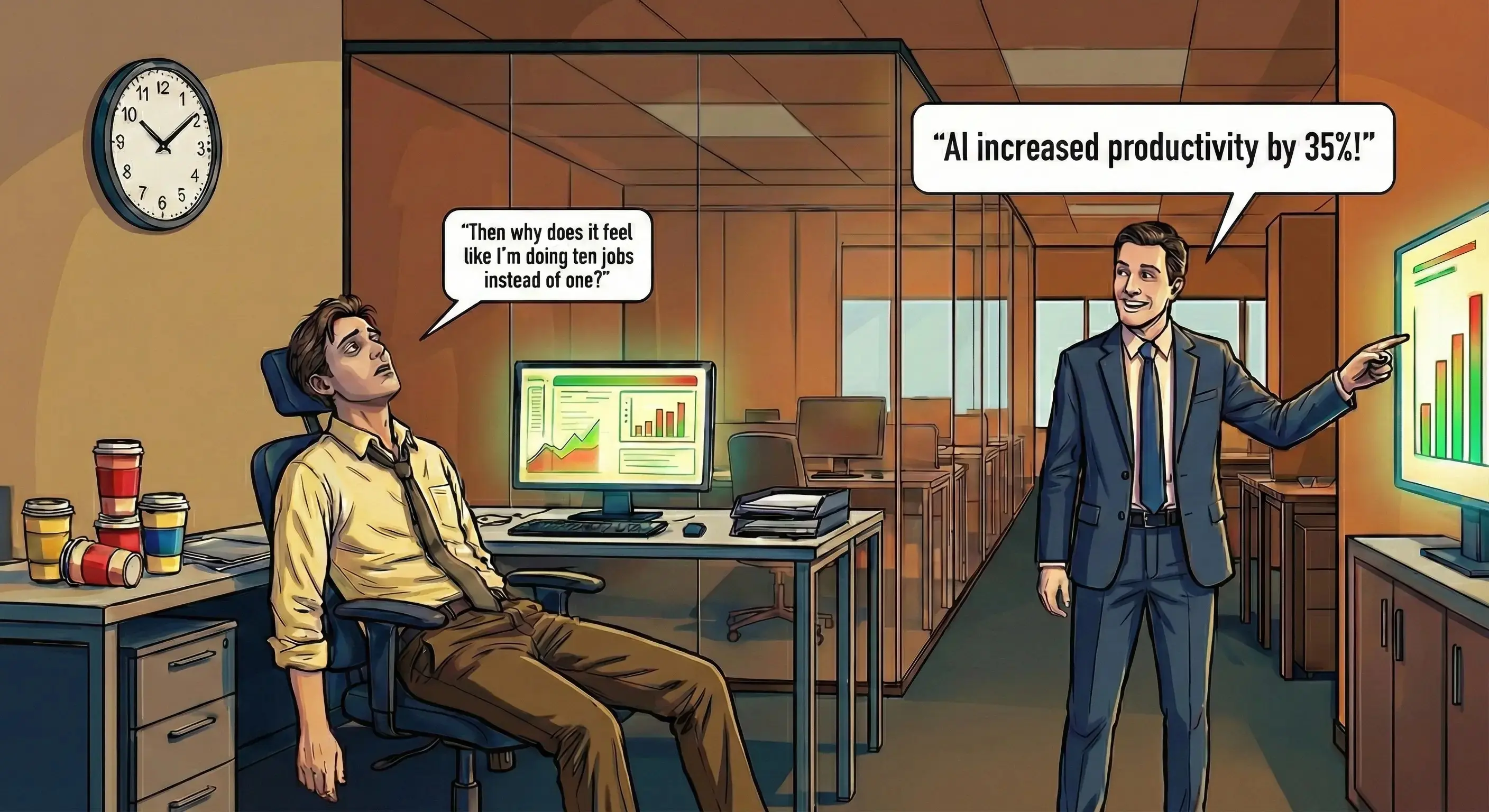
One of the most complex issues we face in the 2026 labor market is the “Productivity Paradox.” On paper, the economic gains are staggering. Research from organizations like the IMF, which estimated in late 2024 that 60% of jobs in advanced economies are exposed to AI, suggests that the throughput of the average knowledge worker has increased by nearly 35% in just two years.
However, this “productivity” has not translated into a four-day work week or increased leisure for the worker. Instead, 2026 has been characterized by an “intensification of labor.” As AI takes over the routine, repetitive tasks, the human worker is left with only the “exceptions”—the difficult, emotionally draining, and high-stakes problems that the machine couldn’t solve.
- The Throughput Trap: When AI summarizes a 50-page report in seconds, the expectation isn’t that the worker has “saved time,” but that they can now process ten times as many reports in a single afternoon.
- The Emotional Tax: In customer service and HR, AI now handles the simple queries (resetting passwords, checking vacation balances). This leaves human agents dealing exclusively with angry, frustrated, or complex human emotions. A 2025 survey by the Upwork Research Institute revealed that while AI users reported major productivity gains, high-performing AI users reported burnout at extremely high rates—currently 40% higher than 2024 levels.
- The Loss of “Micro-Breaks”: The “mundane” tasks that AI has replaced—like filing or manual data entry—often served as mental “palate cleansers” throughout the day. In 2026, workers are finding themselves in a state of constant, high-cognitive demand with no low-stakes tasks to provide mental rest.
The ROI Gap: Why Payroll is the Fastest Lever
A major driver of the 2025–26 layoff waves is the brutal math of Corporate ROI (Return on Investment). Throughout 2024 and early 2025, billions of dollars were poured into AI infrastructure and “pilot programs.” By the end of 2025, a report linked to MIT research suggested that as many as 95% of organizations were failing to see a direct, measurable profit increase from their generative AI pilots.
This created a panic in boardrooms. If the software wasn’t generating new revenue, the only way to justify the massive investment in AI was to cut costs. In 2026, we see that “AI-driven layoffs” are often less about the AI doing the work perfectly and more about the AI providing a modern, shareholder-friendly justification for reducing headcount. When a CEO tells investors they are “restructuring for an AI-first future,” it sounds like a visionary strategy; when they say they are “firing people to balance the books,” it sounds like a failure.
This has led to what many companies in 2026 are now experiencing as a “productivity illusion”—staff cuts made on the promise of AI-driven efficiency, only to find that the remaining employees are overwhelmed because the tools aren’t nearly as capable as the marketing materials suggested. Analysts have noted that firms frequently cite AI as the rationale for layoffs before the underlying systems are mature enough to replace the eliminated roles, creating workflow bottlenecks and operational strain instead of efficiency gains.
The consequences are now visible in hiring data. Workforce analytics from Visier show that 5.3% of laid-off employees are rehired by the same employer, a measurable rise in so-called “boomerang” workers. LinkedIn’s labor-market data reinforces the trend, reporting that boomerang employees now account for 4.5% of all new hires, up from 3.9% before the pandemic. In practice, this means many companies that executed aggressive AI-justified layoffs in late 2025 are now scrambling to rehire former staff and contractors in 2026 to restore institutional knowledge and repair workflows that proved far more fragile—and far less automated—than expected.
The New Class Divide: Who Absorbs the Risk?
As we look at the demographic impact of the 2026 job market, the inequality isn’t just a side effect—it’s a feature of the current transition. The IMF’s earlier warnings about AI exposure have come to fruition: exposure lands unevenly.
In 2026, we are seeing a widening chasm between “System Owners” and “Task Performers.” Those who have the technical literacy to manage, audit, and direct AI systems are seeing their wages skyrocket. Conversely, those who were previously “Task Performers” in routine-heavy roles—even white-collar ones like paralegals, junior accountants, and middle-managers—are finding their bargaining power at an all-time low.
The divide is also geographical and institutional. In regions with strong labor protections, such as Germany and parts of the EU, the transition in 2026 has been characterized by “upskilling mandates” and “automation taxes” that help fund worker transitions. In the U.S. and UK, where labor markets are more “flexible,” the transition has been far more Darwinian. This has led to a 2026 reality where your job security could be determined less by your individual talent and more by the regulatory environment of the country you live in.
Strategies for 2026: Navigating the “Transformation”
If you are a worker in 2026 trying to insulate yourself from the next wave of “strategic realignments,” the old advice of “learn to code” is largely obsolete. In an era where AI can write its own code, the valuable skills are now found in the areas where the machine remains stubbornly incompetent.
- Move Toward Ambiguity: AI thrives on rules, patterns, and historical data. Jobs that require navigating high-ambiguity situations—where there is no “correct” answer or historical precedent—remain the safest harbor in 2026.
- Become an “AI Auditor”: The most valuable person in a 2026 office isn’t the one who uses AI the most, but the one who knows when the AI is wrong. As “AI Hallucinations” continue to plague corporate data, the role of the “Human Verifier” has become a critical, high-stakes position.
- Focus on Stakeholder Orchestration: AI can generate a plan, but it cannot sit in a room with five disagreeing human executives and navigate the ego, politics, and nuance required to get them to agree on a direction. “Orchestration” is the 2026 buzzword for high-level management that cannot be automated.
The Bottom Line: Power, Not Just Progress
As we look toward 2026, it is vital to remember that the “AI Revolution” is not a weather event—it is a choice. The layoffs of 2025 and the hollowing out of roles we see today are the result of specific decisions made by leadership to prioritize short-term efficiency over long-term institutional health.
The 2025 layoff spike wasn’t just about “technological progress”, but rather a massive renegotiation of power between employers and employees. In the “old world,” the worker held the “institutional knowledge” of how things got done. In the “new world” of 2026, companies are attempting to move that knowledge from the heads of their employees into the weights of their proprietary LLMs.
The most important question you can ask your employer in 2026 is no longer about your “career path.” It is about your “data agency.” Who owns the output you produce? How is your “human-in-the-loop” feedback being used to train the very tool that might eventually “hollow out” your role?
We are currently in a period of intense friction. The productivity gains are real, but the human cost is being absorbed by a workforce that is increasingly tired, skeptical, and “hollowed out.” The companies that will ultimately win in the late 2020s are not those who fired the most people in 2025 to “go AI,” but those who used the technology to expand what their people were capable of doing, rather than simply shrinking the number of people they had to pay.As we move through 2026, the goal for every worker should be to stop asking “Will AI take my job?” and start asking, “How do I ensure I am the one holding the leash?” The technology is here to stay, but the terms of our engagement with it are still being written—by us.


Deja un comentario